What should you base your choice of suit on?

Choosing a suit is rarely a routine task.
That is precisely why, rather than following rules, it is worth considering a few basic factors before making a decision.
A good suit is always tailored to a specific occasion.

– How often will you wear it?
– For what occasions do you intend to wear it?
– In which season?
– How long do you intend to wear it for?
– How stable is your build?
– What are your body proportions?
– Which colour best suits your lifestyle?
– How experienced are you in wearing suits?
These aren’t technical questions.
They determine the character of the suit.
This is the first and most important consideration.
A suit worn regularly must meet different requirements to one worn only occasionally. Everyday wear calls for a more hard-wearing, less delicate fabric, whilst for a suit worn less frequently, more distinctive fabrics will also stand the test of time.
The frequency of wear determines the choice of fabric, lining and internal construction. It is always worth discussing these points with your tailor.

Not all fabrics cope well with vigorous movement.
Certain fabrics are more delicate and lose their appearance more quickly when used actively.
The occasion determines not only the fabric, but also the colour and, in many cases, the style.
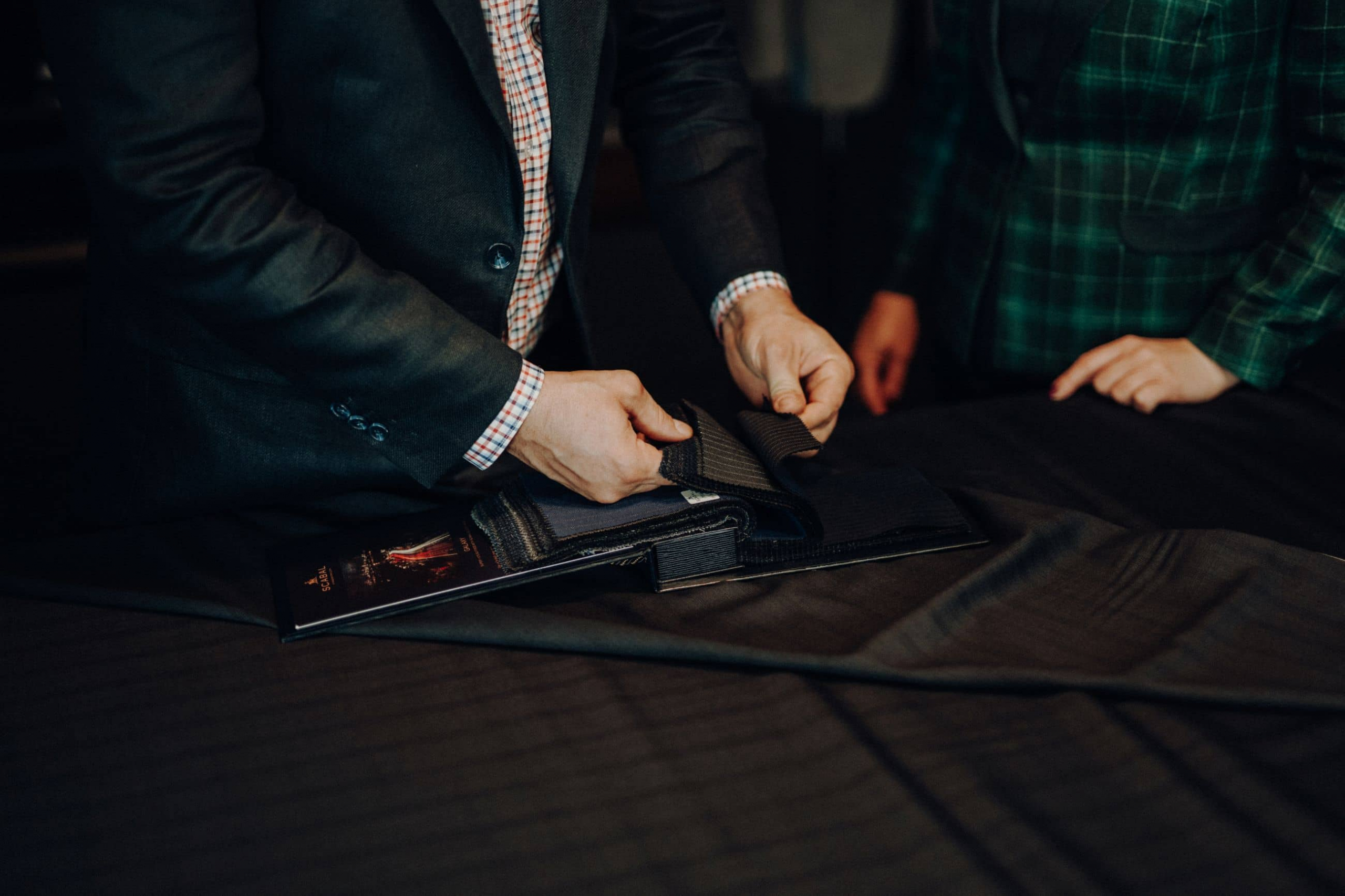
The weight of the fabric is a key consideration.
There are fabrics specifically designed for summer, winter and so-called ‘all-season’ use. The latter are, in fact, more of a ten-month solution: they require a compromise during the peak summer heat.
If you rarely wear a suit, it’s best to avoid extremes — neither fabric that is too light nor fabric that is too thick will be comfortable in the long run.
Some suits are designed for a particular era — and others outlast fashion trends.
If you rarely wear a suit, it’s worth opting for timeless styles. The single-breasted, two-button style and the classic double-breasted style have epitomised timeless elegance for decades.
A suit made to a well-chosen size will remain a reliable choice in the long term.
Some suits are designed for a particular era — and others outlast fashion trends.
If you rarely wear a suit, it’s worth opting for timeless styles. The single-breasted, two-button style and the classic double-breasted style have epitomised timeless elegance for decades.
A suit made to a well-chosen size will remain a reliable choice in the long term.
If your weight fluctuates naturally, it is important that the cut takes this into account.
Extremely tight-fitting styles are short-lived in such cases. A good cut always allows for some give — without losing its character.
A made-to-measure suit can be adjusted, but the aim is not to make alterations too frequently. It is worth discussing this openly right from the design stage.
There are as many styles as there are people.
Single-breasted and double-breasted styles suit different body proportions. The buttoning, the way the jacket fastens and the number of buttons all influence the overall look.
General guidelines are helpful, but the final decision is always based on individual proportions.

Colour is a matter of context.
In a business setting, shades of blue and grey are the safest choices. For casual wear, black takes centre stage — but it is important to note that it is not considered a classic colour in a business context.
If you are considering a single suit, choosing deep blue or dark grey gives you the greatest flexibility.
A good suit doesn’t ask questions.
It answers them..
Colour is a matter of context.
In a business setting, shades of blue and grey are the safest choices. For casual wear, black takes centre stage — but it is important to note that it is not considered a classic colour in a business context.
If you are considering a single suit, choosing deep blue or dark grey gives you the greatest flexibility.
A good suit doesn’t ask questions.
It answers them..


 What should a man’s wardrobe include?